Monday, 31 January 2022

More grayling, and musings on tip colour

Out again on the same stretch as last time, but I thought I'd try something that could carry a little more weight to cast over the other side of the creases I'd previously fished, rather than trotting off the rod tip with a low weight-carrying Righyni style float.

The fish were no less keen once I'd got into a rhythm, first off using a cork-bodied alloy-stemmed Avon I'd made some time ago (slightly obscured under the caudal fin)...


However, the orange tip for me was still a problem. Admittedly I started with the float slightly over-shotted which obviously isn't going to help, but again even with a much-preferred dull-overcast outlook (as per the photo below)


...the orange tip was just getting too difficult to see further downstream, in what was a relatively minor surface disturbance.

Out with another float made a while ago, this time cork on a simple tapered hardwood stem, which has a luminous red tip, although it doesn't look like it in the following photo, it appears in the photo there's greater contrast against the dark red on the cork body...


This particular shot was the nice but out-of-season wild brownie that careered all over that particular swim, disturbing any resident grayling and rendering it seemingly devoid of any fish forcing me to move on. Here are the two floats in question...


Not that different in colour one would have thought, although it did go unnoticed by me at the time whilst re-rigging with the red-tipped float that the tip is a little larger too. 

Anyways, enough rambling. Off to talk about a new club's waters tomorrow as the current club is relinquishing the rights to this particular stretch at the end of this season. I shan't be leaving the club as there are other fantastic stretches of river and some stillwater concessions that I'd like to retain, but unfortunately no other grayling stretches so I need to look at what other options are available locally for grayling, hopefully there'll be at least a day ticket to report on after tomorrow...


Sunday, 23 January 2022

Not all work and no play

The floats have been coming out of the workshop at a slow and steady pace, but the weather had been awful recently, with my local river bursting its banks regularly and the colour of strong tea for what seemed like an age. Eventually a break in the weather for a few days coincided with a little time off and I was able to head out with a pint of reds to see what was about.

The river was finally looking in fine fettle, along with ample raw materials for float making available for collection..


After a recent conversation with a chap regarding the merits of Reg Righyni's design, I had rigged up with one of the first attempts I had turned out, and it was performing admirably, although this was after a swap from a yellow-tipped version to a darker red which showed up a lot better against the bright reflections coming off the water, even with polaroids on.

There were fish about, although without waders one observation which had brought to mind the recent conversation was Righyni's suggestion that with his pattern of float "the stem acts as a keel and the float is self-cocking. With one or two shot on the cast, it floats with the antenna only above the surface." Now obviously Righyni doesn't specify the size of shot, but with a short Nottingham cast on the centrepin and a desire to feather the landing in short succession the float was not the easiest to cast in an awkward wind. And that was with about 1.5 g of olivette and dropper, likely more than Righyni's "one or two shot". 

I don't think it's a great leap of imagination to see Reg Righyni's design a forerunner, albeit with a much smaller shot-carrying capacity, of a thick-tipped and steel or alloy-stemmed Bolo float, and that may be the next step if a further cast to get the trot where you want is required. Something for the workshop should the weather turn perhaps.

Righyni also extolls the value of braid in his 1968 publication of "Grayling", whilst pragmatically recognising it does have shortcomings, particularly on windy days. His conclusion was that mono on a fixed spool reel and braid on a centrepin were the inevitable conclusion for "dedicated long-trotters", it may be something I'll try but not until it's time to replace the mono on the 'pin.


Incidentally, the reel I was using and in the above photo is a Vectra SST-3 from Canadian tackle company Raven, in case it's not instantly recognisable for European readers. Made for steelhead float fishing in Canada and the US, what little I have read about it did suggest it was more popular on shorter float rods, it's light weight apparently making it less desired for 13 foot rods or longer. I picked it up cheaply on a well-known auction site some years ago probably due to it being little known on this side of the Atlantic, and personally I found it suited the 13ft Acolyte Plus perfectly, maybe down to the very light weight of the rod. The reel weighs just under 190g loaded with 100 yards of 4lb mono, compared to, say, a J W Young Purist II at 290g weighing half as much again. Combined with one of the lightest 13ft float rods available it was a pleasure to use all day. (Yes I know there are a couple of lighter rods out there, I have at least one, but not at the price or with Drennan's availability in almost every tackle emporium you venture into).

Besides, if a rod is tip heavy adding weight at the fulcrum or pivot-point of the lever is not the best way to balance the rod, weight at the butt is going to be more effective.

Hopefully the weather will hold out for a couple more trips before the end of the season, whereupon a short break will hopefully be followed by a campaign chasing the local Crucian populations.

Thursday, 26 August 2021

New set of Avons

One cannot fail to be impressed by the standard of work and attention to detail exhibited by some of the better known names of float making in the UK, irrespective of whether the design or style in question is to your liking, as such things are somewhat subjective.

It struck the other day however, amongst the feathers and multi-coloured whippings (even those can be in a multitude of thread types/materials) that the classic floats which surely provide at least a modicum of inspiration had no such extravagance.

Looking at a previous post entitled 'Genuine vintage floats' with some samples from the better known commercial makers, such as those shown below from Auger, any small lines used to delineate between different colours or possibly just for the ability to see a sensitive bite more clearly were painted on.

Auger selection

...albeit neither straight nor consistent in width in some cases. The only whipping on these and others of the time were to secure the eye at the end of the stem.

So I thought I'd see what i could do to replicate the design and feel without the plethora of whipping, and to be honest I don't think they came out too bad (straighter than some of the vintage examples at least)...

Cork Avons


Not 100% sure about the choice of colours, and they're as yet untested, but I thought the lack of luminous tips was a bit more in keeping with what I was trying to do, and recreating the classic Harcock red bands on yellow is a bit cliche nowadays...


Cork Avons up close


True to form, the only whipping on each float is to secure the stainless eye, albeit diverging from the plan slightly by being subtly tipped with a little gold.


So, they'll be up for sale shortly in the Etsy shop in case anyone wants them, with more to come soon as I think it suits some of the more functional designs. No doubt there'll still be a selection with fancy whippings, incorporating porcupine quill sections and so on to cater for all tastes. Surprisingly these don't seem to take any less time to make, except for maybe less time taking decisions on the design...

Tuesday, 17 August 2021

A bit of a hiatus from the blog for a short while...

I finished some grayling floats, admittedly a while ago, for the same recipient as the crowquill Avons...

Reg Righyni grayling floats


In addition there's a modern take on a sensitive Avon float for roach on the river, slim 3 mm tip for sensitivity, carbon stem to help with detecting bites on the drop, I've made some up previously for myself to test them out and they work a treat if you're not trying to cast to the other side of the river...

More traditional paint, and a light Avon float


In other news, single floats, pairs and the odd set of three have made their way onto a new Etsy shop. I'm making far too many to use, but still enjoy making them, so hopefully selling a few will cover the cost of materials and give me an excuse to keep on making them...

If you want to see what's there here's a link, the stock will be updated as and when completed....


Wednesday, 17 February 2021

Set of avons

Something else from the workshop this week, a group member on one of the Facebook groups I belong too saw a post from the friend whom I made some floats for previously which he had reposted, and got in touch to request something similar.

Here's the results, although the request was for quill for all the stems rather than cane as in the previous batch, so there's one pheasant and two crow...


Dorset flag colours on the left again, and a bit of jasper thread for some of the whipping on the other two


The recipient was very pleased, so much so that he immediately requested some Reg Righyni-style grayling floats, which will be next on the cards...


Crucian hybrid (float, that is)

I started playing with a float just to see if something would work, namely using a cut-down pole float tip for the tip on a bodied waggler. The stem is pheasant tail quill, and I got carried away and used an off cut of porcupine quill for the stem and ended up giving it the full stain, paint and whipping treatment. Came out quite well I thought....


the finished float


the pole float tip in place


close-up

Would I do it again? Yeah, probably, I don't dislike the look of the pole float tip, it's hollow and is quite bright in direct sunlight. I also quite like, in this case at least, the increase in diameter from the quill to the pole float tip. So, more to come maybe....


Tuesday, 21 July 2020

Brace of pairs

After a bit of a tangent as described in the previous post, and a brood lull in proceedings, a couple more pairs have reached the final stage of the production line. Two pairs of floats, each pair consisting of a bodied waggler and matching Avon


I played a bit with some different silks for the whipping...


I'm happy with the wood dye used to colour the balsa bodies, but I have got some new dyes to try, after the next batch on cork, and the batch after that that had already been dyed with the teak dye you can see here. More to follow shortly...

Monday, 15 June 2020

Something slightly different

Production of floats has been on hold a week or two whilst I spent some time putting together an extended tool rest for a friend's Proxxon DB250 lathe.

A lot of folk think it's perfect for float making, the size is certainly convenient but personally I'd like a quick-drilling tailstock and a slower minimum speed.

The factory tool rest is not only short but also aluminium and easily scored which makes smooth passes with a gouge a little awkward. Not all users are bothered as a lot would use glasspaper almost exclusively, but if you want to get a body concentric around the axis of rotation a tool on a test is essential.

Here's my offering about to be posted to the friend in bonnie Scotland...


150mm long, 12mm diameter in 303 stainless should be a little more difficult to score, although there's quite a bit of twisting force you can apply at either end due to the leverage of the longer tool rest which the alloy plate doesn't handle that well, maybe that's why Proxxon only offered the short tool rest. We'll see how the testing goes.

Meanwhile, back to the floats next post...


Monday, 8 June 2020

Interlude

For a break from the pairs or sets of near identical floats worked on recently, I picked out one of the single floats awaiting finishing, a cork on cane waggler, on which I decided to experiment with some alternative whipping. Whipping for me up until now has been like Henry Ford's model T, available in any colour so long as it's black.

So, here it is in its raw form, looking a bit chintzy like an old school tie...


And a closeup after a couple of coats of sealer and 4 or 5 coats of lacquer. 


Fortunately the red still mellowed a little despite the sealer, a couple more coats of lacquer to go and we're done


Saturday, 23 May 2020

...and number four

Yet more Reg Righyni grayling floats, this time with a balsa tip and some internal reinforcement to make sure there's no problems when adjusting the float cap...

I think that's enough of those for a while, there's another design I'll be trying shortly once I've worked my way through some more of the part-finished stock

Sunday, 3 May 2020

Batch number three

The next batch to emerge from the workshop, predominantly grayling floats following Reg Righyni's timeless formula, with a couple of minor modifications. These are fitted with hardwood tips for a little extra strength for the float caps, and the recommended 20swg (0.91mm) piano wire, basically spring steel, has been replaced with 1mm stainless steel.

Where the magic begins in 'Fishing Reflections'


And in addition a couple of simple balsa on cane Avon's with colour scheme inspired by the county flag..


Saturday, 18 April 2020

Second new batch

The second set of finished floats from those awaiting completion in the shed.

A bodied waggler, balsa on cane, and matching crucian waggler of balsa on pheasant quill. I quite like the way the pheasant quill has turned out, it seems difficult to tell if the quill is going to show a pleasing pattern or not before the herl is removed.


Another worthwhile read


Whilst the part-finished floats seemed too good to discard but still a bit of a burden at first, it appears the spindle on the lathe I use to turn bodies now has an unacceptable amount of run out and as such is out of commission, so the old stock awaiting completion is now a blessing until a repair is possible or a replacement lathe sourced.

Every cloud and all that, I feel a new investment for the shed coming on....


Tuesday, 14 April 2020

New floats

Seems like the most frequent here is going to become the one where I try and justify the break in blogging. So usual stuff going on, changing priorities, other hobbies, blah.

Needless to say I shall do my best to keep updates as regular as possible. In the meantime, I've decided to try and finish the nearly sixty floats (some of which can be seen in the earlier photo below) that I've started but not yet finished, in a state from nothing more than a body and stem to just requiring the whipping and varnish.


So first up is the five floats in the following picture, a balsa on cane gudgeon float, two cork on cane grayling bobbers, a cork on cane Avon and a cork-bodied alloy-stemmed Avon (not a combination I recall seeing a large number of I admit...)


More to follow shortly


hopefully

Monday, 11 February 2019

Following another break in transmission

Another long break in communications for which I can only apologise, lots going on distracting me from the updates. First of all the new Avid HQ, erected from scratch and promptly filled to the brim with both useful and some not quite so useful stuff....

Those are brass chips on the work bench in front of the lathe, more on that later


In the meantime, several sets of floats are in various stages of production, the first of which had to be finished before Christmas as it was ordered as a gift. The recipient is ex-Royal Corps of Signals, and still fiercely loyal, so the order came in with a request for any sort of reference to the Corps to be included...


Here's the finished set, I wanted to include the figure of Mercury (affectionately known by the Corps as 'Jimmy' apparently) but the dark float body in combination with the need to have white within the transfer (printers than can actually print white don't come cheap) meant it was just the colours included...


Margin pellet waggler weighted such thattit needs just a couple of BB shot to lock it in place, and the pellet then falls unweighted to match as nears as possible the free offerings, and a weighted parachute waggler inspired by Middy's offerings...


Pheasant tail wagglers with sight bobs....


And a cork-bodied weighted waggler


More updates to follow as soon as the other sets are completed....

Wednesday, 20 June 2018

Zephyr floats

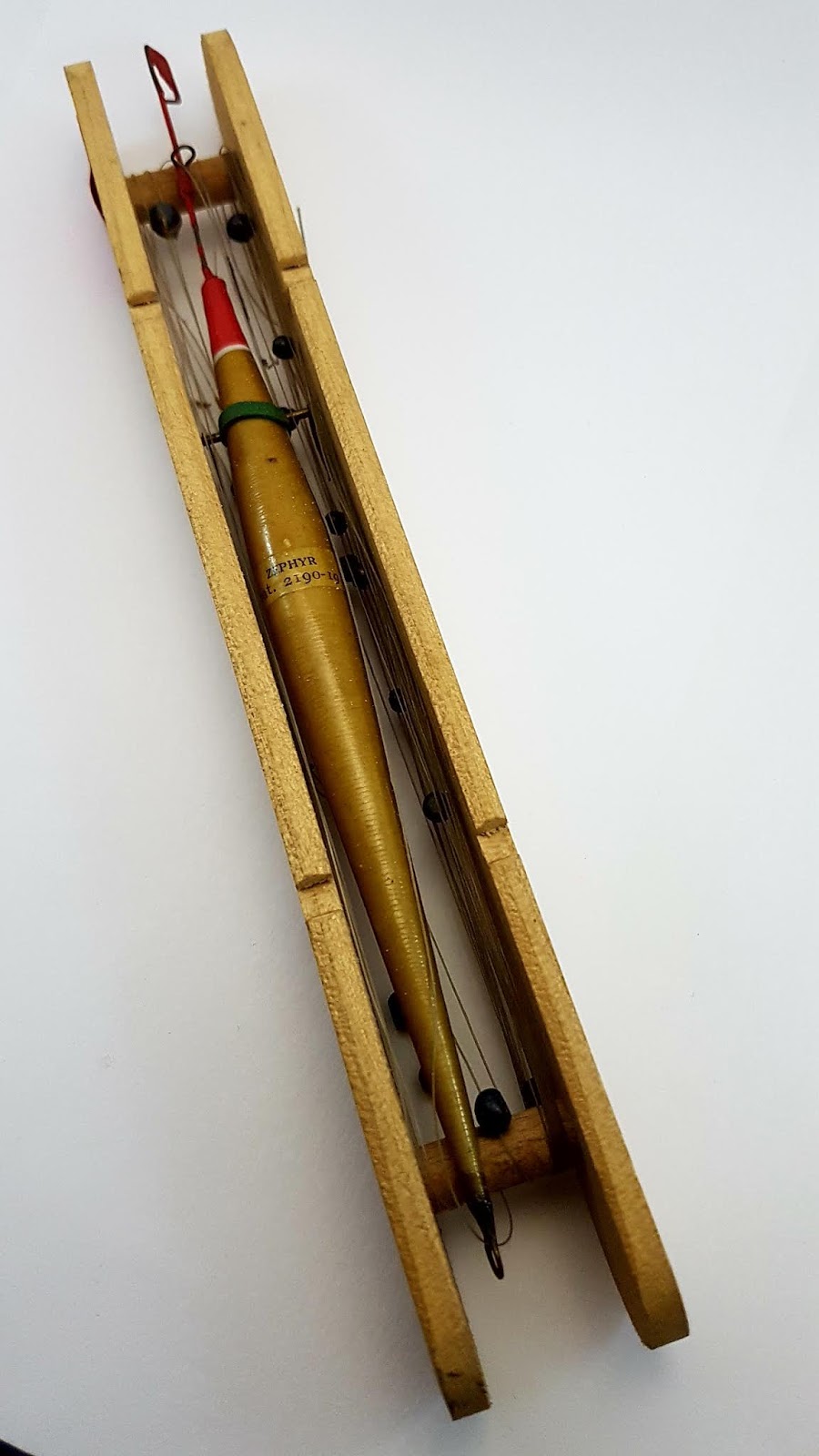
Having been blessed with a beautiful baby daughter a couple of years ago, I was lucky enough to receive a perfect Father's Day gift this last Sunday (with a little help from Mrs Avid obviously).


Zephyr Antenna float

In 1919, according to Keith Harwood in "The History of the Float", a Mr E Talbot took out the first of two patents for a float made of paper. Zephyr floats, as they were named were manufactured in a wide range of patterns and sizes by Zephyr Angler's Supplies Ltd of Lowestoft. Given the materials used and that they ceased manufacture in the early 60's, making any remaining examples at the very least 50 years old, they're quite sought after by collectors.


Their passing was much lamented by Bill Watson in his book "the Floatmakers Manual", after trying unsuccessfully to recreate the patterns, although there seems to be some differences of opinion on a manufacturing process. In "History of the Float" Keith Harwood refers to Kenneth Mansfield's "Fly Tying, Rod and Tackle Making" should the reader wish to try their hand. The author suggests winding a triangular shaped sheet of paper around 'appropriate sticks' (his words, not mine) to build a body, with different ratio of sides of the triangle and different thicknesses of paper producing different body shapes. I've seen similar suggestions on a couple of forums too. Another suggestion found was to use the stick/dowel as a mandrel, removing it after the paper is wound and glued/varnished to maintain it's shape, with balsa used to plug each end to form a tip and stem.  


Apparently the 5B size refers to 5 inch/'broad' body
A little further searching showed the following patent drawing showing the previous idea was nearly there, albeit the mandrel being used was conical to shape the body and no doubt reduce the number of layers of paper and subsequent weight, rather than a parallel sided hollow in the body produced by a straight dowel and many more layers of paper. 

Zephyr float patent drawing


Other forum posts also suggest 'the right sort of paper just isn't available any more' to get the right size/weight ratio, the posters having tried all sorts including cartridge, brown wrapping paper etc. Apparently tissue paper is the answer, preferably high quality such as that used by aero modellers.

Something to maybe try out when I really do have time on my hands, which at the moment isn't going to be soon. Still the genuine example shown on the float winder will be much treasured and probably not fished with for fear of loss. Mrs Avid admits to paying far too much than she though she should for this particular example, so if anyone was watching it on a certain well-known auction site and wondered who it was, then now you know.

In the meantime I had a couple of hours out on the river yesterday, with plenty of roach, dace, perch and juvenile chub to show for it but nothing of any size. I blame the conditions of very clear water, lots of weed and low water levels (of course it wasn't the angler or his skill). There's was a match on the same stretch later in the day, so I chose a minimalist roving approach and made sure to only stay a short while in each swim so as to not favour any particular peg with my loose feed/groundbait or the lucky angler picking it later, but it'll be interesting to see the results.


The first peg
Highlight of the day was finding a coupe of swan quills and just getting out back on the river after the close season, in the fresh air and peace and quiet for a while, hopefully things will pick up later in the year when the levels return to normal

A damselfly resting on the tip of my (home-made of course) crow-quill Avon


Friday, 15 June 2018

Avons ready for the new season

Some Avons prepared for the new season, completed 36 hours before the rivers re-open (in England anyway, for international readers. Not sure Scotland for example has a closed season....)


On the left, balsa on crow quill, and on the right balsa on pheasant tail, both in Dorset county flag colours


Three balsa on birchwood Avons, the colouring came out particularly nicely on the stems after the first coat of dye, so much so I didn't bother with any subsequent coats

Best of luck to all venturing out for the new season tomorrow...

Friday, 1 June 2018

Going traditional

Found some elder (sambucus) lying around on a walk down the lane with Avid Junior so thought to grab a handful as it's not something I've used before. Fortunately picking the bark off the pith (insert suitable joke here) with a  thumbnail was possible, but it's pretty delicate stuff.


Not sure how best to drill for a quill or cane stem, might have been better done before I stripped the bark off, still I've plenty more to play with if that's the case.

Results will be posted in due course, after a couple of sets of reed floats and a set of assorted Avons are finished....


Monday, 28 May 2018

'Genuine' vintage floats

This might be a little contentious, but I'll say it anyway... there appears to be a surfeit of handmade floats around that claim to be 'vintage', a significant proportion of which are for sale on that well-known auction site. I won't comment on the items themselves nor the quality, which does appear to be... shall we say... 'variable'. I do get a little perplexed as to whether or not  brand new float, irrespective of the quality of finish, can be labelled as 'vintage'.

The OED defines 'vintage' thus:


adj: Denoting something from the past of high quality, especially something representing the best of its kind

Vintage-style may be a little more accurate, or maybe just 'retro', but both seem a little out of sorts with the sort of person I imagine to appreciate said items, assuming the originality is highest priority. I wouldn't call any of the floats I'm producing 'vintage' despite a lot of them being inspired by classic designs from the past...

Either way, enough musings, I do have a genuine vintage collection that will be moved on soon. I've decided I'm going to fish with nothing but floats I've made myself, save for a small collection of grayling floats from past manufacturers that inexplicably garner my affections. Some are in need of a little TLC, a new eye to be whipped on and/or a lick of paint. A few need slightly more attention than that, and given their originality is going to be much more greatly affected I might keep hold of those few that need major restoration.

Examples that will be going up for sale from Allcocks...


Belglow...

Auger...


and of course Harcork...


and some nice small sliders, manufacturer yet to be confirmed...


I love a lot of the designs but fear I shouldn't fish with them for fear of losing an original up a tree on the opposite bank as is so often the case, so the next logical step of not using them 'in anger' myself is to use them as inspiration for my own floats, and then sell them on as otherwise they're only ever going to be collecting dust.


How I'll offload them is as yet undecided, either a couple of specialist Facebook groups I'm a member of or that well-known auction site, if any reader is interested in anything in particular then please get in touch via the 'Contact me' widget in the right-hand toolbar (if you're on a mobile device scroll to the bottom of the page and select 'View web version' to see it) or leave a comment on the post.